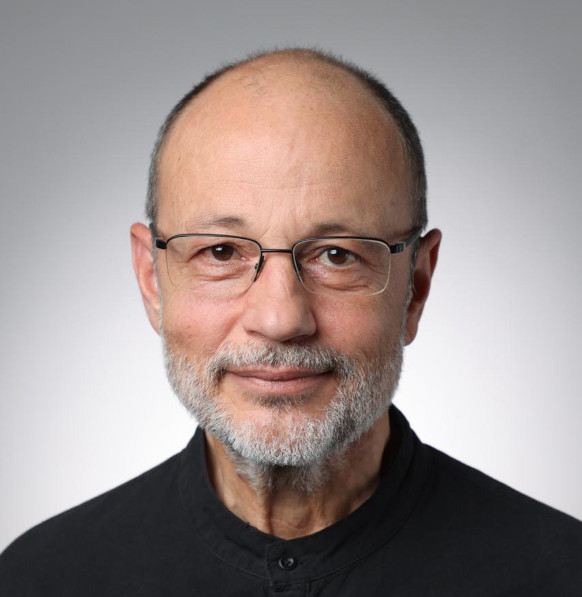
Dr. Vassily Hatzimanikatis is Associate Professor of Chemical Engineering, Chemistry and Bioengineering at Ecole Polytechnique Federale de Lausanne (EPFL), in Lausanne, Switzerland. Dr Hatzimanikatis' research interests are on systems and synthetic biology, with focus on evolution and design of metabolism, integration of omics data, bioenergetics, microbial communities, biodegration, and biochemical and biophysical kinetics. Dr Hatzimanikatis is a fellow of the American Institute for Medical and Biological Engineering (2010), he was a DuPont Young Professor (2001-2004), and he has also received the Jay Bailey Young Investigator Award in Metabolic Engineering (2000), the ACS Elmer Gaden Award (2011), the Metabolic Engineering Award from the International Society of Metabolic Engineering (2014), and the ACS BIOT Marvin J. Johnson Award (2026). He also serves as associate editor of the journals PLOS Computational Biology and Biotechnology & Bioengineering and, and Senior Editor of Biotechnology Journal.
Τίτλος παρουσίασης: Chemical Engineering Foundations of Systems and Synthetic
Biology
Περίληψη: Systems and synthetic biology increasingly rely on concepts that are central to chemical engineering, including mass balances, reaction networks, thermodynamics, kinetics, transport, and optimization. These principles provide a rigorous framework to move from molecular descriptions of biological systems to quantitative models that enable understanding and design.
Selected examples illustrate this perspective. First, stoichiometric and thermodynamic constraints are used to analyze metabolic networks and identify feasible cellular states, while methods from reaction engineering enable the design of novel metabolic pathways. Second, kinetic and thermodynamic considerations reveal pathway limitations and guide metabolic engineering strategies. Finally, examples from microbial communities demonstrate how methods from process systems engineering can be applied to study the function of organisms within complex and interacting systems.
The central message is that chemical engineering offers not only a set of tools, but a
unifying conceptual framework to connect molecular mechanisms with system-level
behavior and to support rational design in systems and synthetic biology.